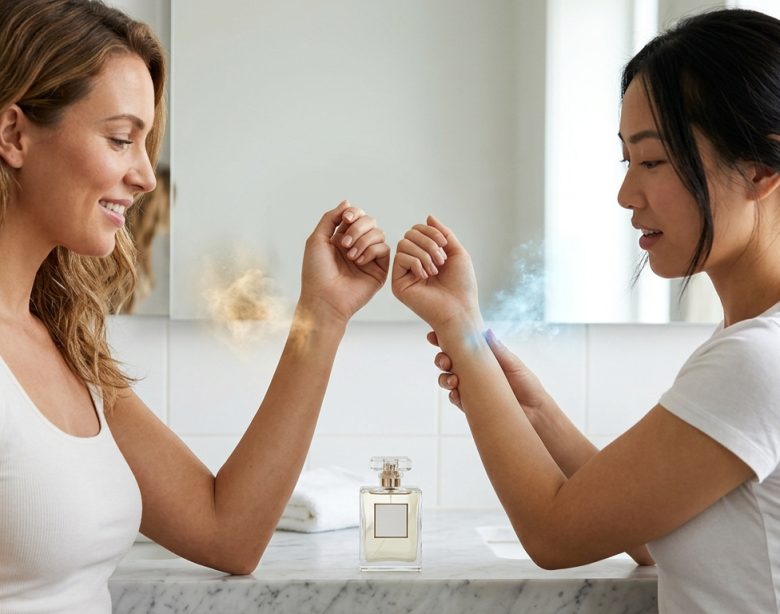
You spray the same perfume your friend wears, but it smells completely different on you. Not bad, just different. Maybe sweeter, maybe sharper, maybe it fades faster or lingers longer. You’re not imagining it. Your body chemistry is literally rewriting the fragrance formula the moment it touches your skin.
Perfume smells different on everyone because your skin’s pH, natural oils, diet, medications, and hormones interact with fragrance molecules to create a unique scent. Factors like skin hydration, body temperature, and even what you eat can amplify or mute certain notes, making the same perfume smell completely different from person to person.
Your skin chemistry is rewriting the formula
Your skin isn’t a neutral canvas. It’s a living, breathing ecosystem with its own pH level, oil production, and bacterial balance. When perfume touches your skin, it doesn’t just sit there. It reacts.
Skin pH typically ranges from 4.5 to 6.5. If your skin is more acidic, it can make citrus and floral notes sharper and more pronounced. If your skin is more alkaline, those same notes might smell softer or fade faster.
Your natural skin oils play an even bigger role. Oily skin holds fragrance longer because oils trap scent molecules. Dry skin, on the other hand, absorbs fragrance faster and releases it more quickly into the air. That’s why the same perfume might last eight hours on your friend but barely three on you.
The bacteria living on your skin also contribute to your unique scent profile. Everyone has a different microbial community, and these microorganisms interact with fragrance compounds in ways science is still trying to fully understand.
Diet changes how you smell
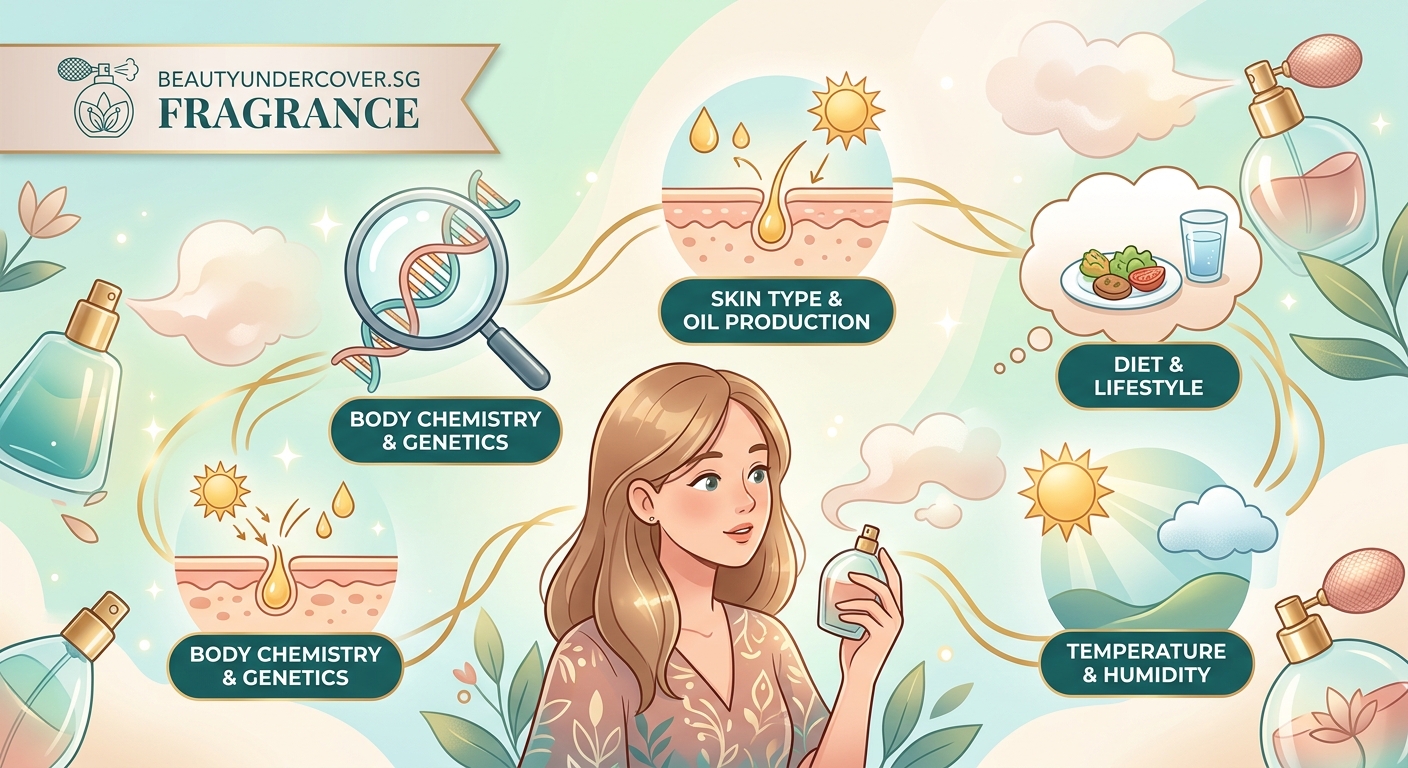
What you eat directly affects your body odor, and that body odor mixes with your perfume. It’s not just about garlic or onions, though those definitely have an impact.
Spicy foods can increase your body temperature and make you sweat more, which dilutes perfume and changes how it projects. Red meat has been shown to make body odor stronger and more pungent, which can clash with lighter, fresher fragrances.
Coffee drinkers often notice that perfumes smell different on them compared to non-coffee drinkers. Caffeine affects your metabolism and sweat composition, subtly altering your skin chemistry.
Even your water intake matters. Dehydrated skin absorbs perfume faster and releases it differently than well-hydrated skin. If you’re not drinking enough water, your perfume might smell more concentrated at first, then disappear faster.
Hormones are constantly shifting your scent
Your hormonal balance changes throughout the month, throughout your life, and even throughout the day. These shifts directly impact how perfume smells on you.
During menstruation, many people notice their perfume smells stronger or different. Estrogen levels drop, which can make skin drier and change how fragrance molecules evaporate.
Pregnancy completely transforms how perfumes smell. Hormonal surges increase blood flow to the skin and change oil production. Scents that smelled beautiful before pregnancy might suddenly smell overwhelming or completely different.
Birth control pills, hormone replacement therapy, and other medications that affect hormones will also change your fragrance experience. Some people find their signature scent no longer works for them after starting or stopping these medications.
Stress hormones like cortisol also play a role. High stress increases sweat production and changes your body’s natural scent, which mixes with whatever perfume you’re wearing.
Temperature and environment matter more than you think
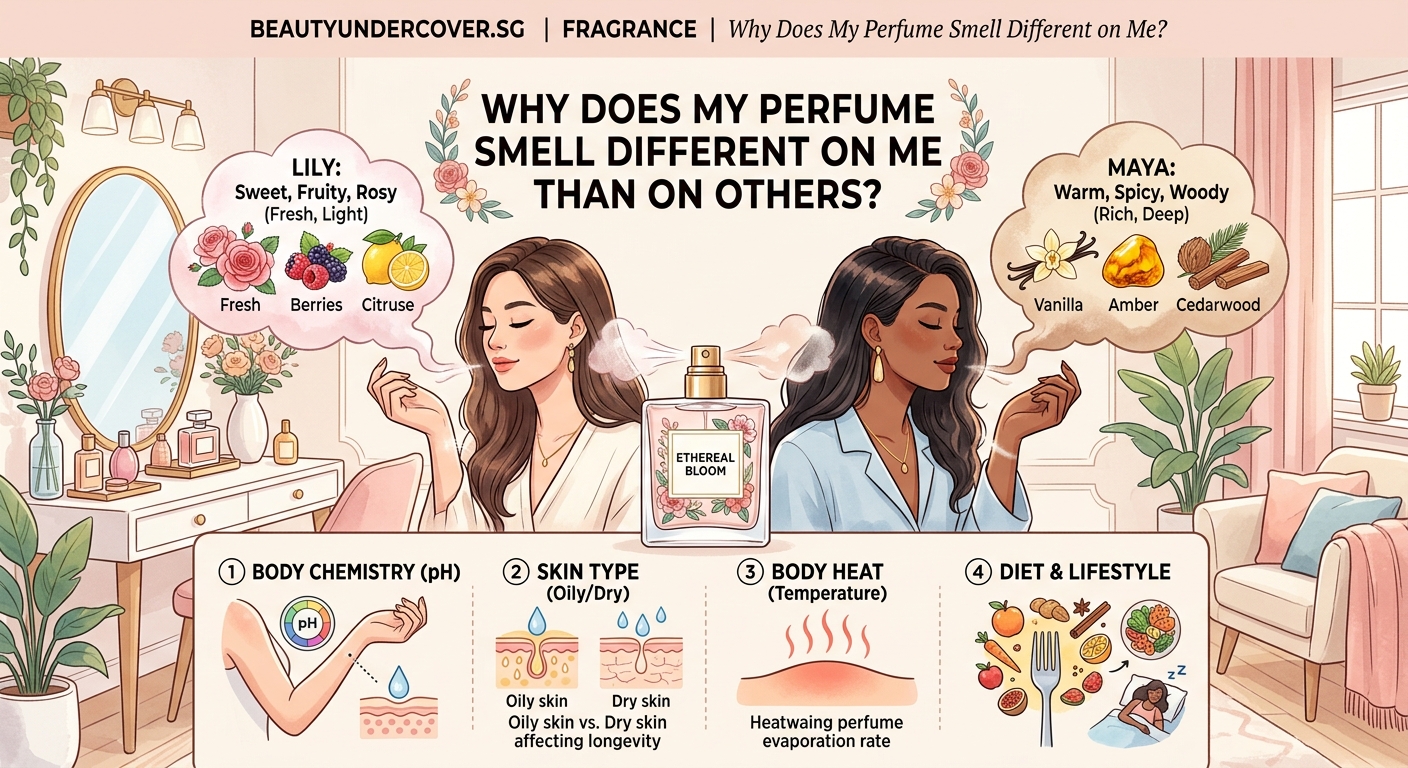
Your body temperature affects how fast fragrance molecules evaporate. People with naturally warmer skin will project perfume more strongly and burn through it faster.
If you exercise regularly or run hot, you’ll notice perfumes smell more intense on you. The heat accelerates evaporation, releasing more scent molecules into the air around you.
The environment you’re in also changes perfume performance. Humidity makes fragrances smell stronger and last longer because moisture in the air slows down evaporation. In dry climates, the same perfume will smell lighter and fade faster.
Season matters too. That heavy vanilla perfume that smells amazing in winter might turn cloying and headache-inducing in summer heat. Your skin temperature rises in warm weather, which amplifies certain notes while muting others.
Even the clothes you wear affect how perfume smells. Fabric absorbs and holds scent differently than skin. Perfume on a cotton shirt will smell different than perfume on your wrist, and different again on synthetic fabrics.
Medications and supplements alter your chemistry
Prescription medications change your body chemistry in ways that directly impact fragrance. Antibiotics, antidepressants, and blood pressure medications can all affect your natural scent and how perfumes interact with your skin.
Supplements do the same thing. Vitamin B complex supplements, for example, can make your sweat smell different, which then mixes with your perfume. Fish oil supplements might add a subtle note that clashes with certain fragrances.
Even over-the-counter medications matter. Antihistamines dry out your skin, which changes how perfume absorbs and evaporates. Pain relievers that affect your circulation can change your skin temperature, altering fragrance projection.
If you’ve recently started or stopped any medication and your favorite perfume suddenly smells wrong, this might be why.
How to test perfume properly before buying
Testing perfume in a store requires strategy. Don’t spray it on a paper strip and call it done. Paper doesn’t have skin chemistry, oils, or body heat. It will never smell the way it will on you.
- Spray the perfume on your wrist or inner elbow, not on your clothes or a tester strip.
- Wait at least 15 minutes before judging the scent. The top notes need time to evaporate and reveal the heart notes.
- Smell it again after 2 hours to see how the base notes develop on your skin.
- Wear it for a full day if possible. Ask for a sample to take home and test it in different environments.
- Don’t test more than three fragrances at once. Your nose gets overwhelmed and you won’t be able to distinguish between them accurately.
Keep in mind that your skin chemistry changes throughout the day. A perfume that smells perfect in the morning might smell different by afternoon once you’ve eaten, had coffee, or dealt with stress.
Common mistakes that change how perfume smells
Rubbing your wrists together after applying perfume is one of the worst things you can do. The friction generates heat and breaks down the fragrance molecules, changing the scent before it even has a chance to develop properly.
Applying perfume to dry skin is another mistake. Moisturized skin holds fragrance better and releases it more evenly. If you have dry skin, apply an unscented lotion first, then spray your perfume. Some people even use the best hydrating serums for dry skin under $30 on pulse points before perfume to help it last longer.
Spraying perfume on your clothes instead of your skin might seem like a solution, but fabric doesn’t activate fragrance the way skin chemistry does. You’ll get a flat, one-dimensional version of the scent.
Storing perfume in your bathroom is terrible for longevity. Heat and humidity degrade fragrance compounds. Keep your perfumes in a cool, dark place, away from temperature fluctuations.
Why the same perfume smells different at different times
Your perfume might smell different on Monday than it does on Friday, even if nothing else has changed. Your body isn’t static. Your skin chemistry shifts constantly.
Your menstrual cycle affects everything. During ovulation, heightened estrogen can make skin oilier, which holds fragrance longer. During your period, lower estrogen can make skin drier, changing how perfume projects.
Sleep quality matters. Poor sleep affects cortisol levels, which changes your body’s natural scent. If you’re exhausted, your perfume might smell different than when you’re well-rested.
What you ate yesterday can still be affecting your body odor today. That garlic pasta from dinner is still working its way through your system, subtly changing your skin chemistry.
Even your workout schedule plays a role. Regular exercise changes your sweat composition over time, which affects how fragrances interact with your skin.
The science behind fragrance notes and skin chemistry
Perfumes are built in layers: top notes, heart notes, and base notes. These layers evaporate at different rates, and your skin chemistry affects each layer differently.
Top notes are the lightest molecules. They evaporate within 15 to 30 minutes. Citrus, herbs, and light florals are common top notes. If your skin is very oily, you might barely notice top notes because they get absorbed quickly. If your skin is dry, top notes might project strongly but disappear fast.
Heart notes appear after the top notes fade, usually lasting 2 to 4 hours. These are the core of the perfume. Florals, fruits, and spices typically make up the heart. Your skin’s pH has the biggest impact here. Acidic skin can make florals smell sharper, while alkaline skin makes them smell softer.
Base notes are the heaviest molecules. They can last 6 hours or more. Woods, musks, and vanilla are common base notes. Your body temperature determines how strongly these project. Warmer skin amplifies base notes, sometimes to the point where they overpower everything else.
| Skin Type | How It Affects Perfume | What To Look For |
|---|---|---|
| Oily | Holds fragrance longer, projects strongly | Lighter fragrances to avoid overwhelming |
| Dry | Absorbs fragrance quickly, fades faster | Richer, longer-lasting formulas |
| Combination | Uneven projection, changes throughout day | Balanced scents that develop well |
| Sensitive | May react to certain ingredients | Hypoallergenic or natural fragrances |
What perfume experts want you to know
“Your skin is the most important factor in how a perfume smells. I’ve seen the same fragrance smell like roses on one person and like soap on another. It’s not the perfume that’s different, it’s the person wearing it. That’s why you should never buy a perfume based on how it smells on someone else.” – Master Perfumer, quoted in fragrance industry interviews
Professional perfumers design fragrances knowing they’ll smell different on different people. They’re not trying to create one universal scent. They’re creating a formula that will interact with individual chemistry in interesting ways.
This is why how to make your perfume last all day: 10 expert application tips focuses so much on skin preparation and application technique. The same perfume can perform completely differently depending on how you apply it.
Some perfumers actually prefer how their fragrances smell on certain skin types. A perfume designed to be fresh and clean might smell more interesting and complex on someone with oily skin who brings out the deeper notes.
Finding fragrances that work with your chemistry
Understanding what do fragrance notes actually mean? a beginner’s guide to understanding perfume helps you identify which note families work best with your skin chemistry.
If florals always smell soapy on you, your skin might be more alkaline. Try fragrances with stronger base notes like woods or musks that can balance out the floral sweetness.
If citrus scents disappear within an hour, your skin is probably dry or you have lower oil production. Look for citrus fragrances with strong base notes that will stick around after the top notes fade.
If everything smells too strong on you, you might have warmer skin that amplifies fragrance. Choose lighter concentrations like eau de toilette instead of eau de parfum, or look for best summer perfumes that won’t overwhelm in the heat.
Keep a fragrance journal. Write down what you wore, what you ate that day, where you were in your cycle, and how the perfume performed. Patterns will emerge that help you predict which fragrances will work for you.
Your unique scent signature is actually a good thing
The fact that perfume smells different on everyone isn’t a flaw. It’s what makes fragrance personal and interesting.
When you find a perfume that works with your chemistry, it becomes yours in a way that’s impossible to replicate. Someone else can buy the same bottle, but it will never smell exactly the way it does on you.
Your body chemistry creates a signature scent that’s as unique as your fingerprint. The perfume you choose is just one ingredient. Your skin, your diet, your hormones, your lifestyle – all of these combine to create something that belongs only to you.
That’s why blind-buying perfume based on online reviews is so risky. A fragrance that smells amazing on a reviewer might smell completely wrong on you, not because the perfume is bad, but because your chemistry is different.
Testing perfume on your own skin, in your own environment, living your own life, is the only way to know if it will work for you. Take your time. Get samples. Wear them for full days. Pay attention to how they change as your body changes.
The perfume that smells perfect on you right now might smell different in six months when your diet changes, when you switch medications, when the seasons shift. That’s not a problem. That’s just your body doing what bodies do.
Your chemistry is constantly writing and rewriting your scent story. The perfume is just giving it something interesting to say.