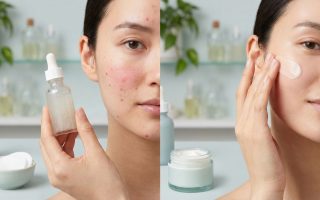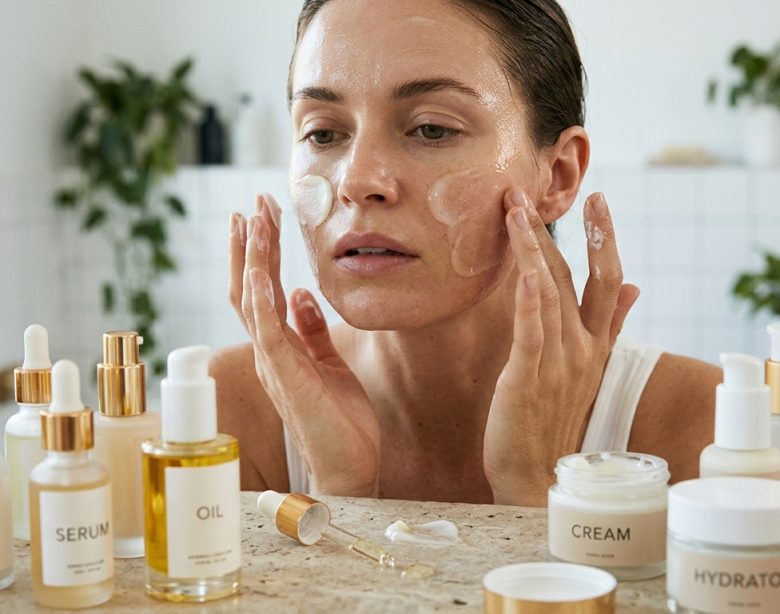
You bought another serum. Then a toner. Then an essence because your favorite influencer swears by it. Now your bathroom shelf looks like a skincare store, and your skin looks worse than when you started with just cleanser and moisturizer.
Sound familiar?
Layering too many skincare products overwhelms your skin barrier, prevents proper absorption, and often causes irritation, breakouts, and sensitivity. Most skin types need only four to six products maximum. More steps don’t equal better results. Your skin has limits on what it can absorb, and overloading it creates problems instead of solving them. Quality and compatibility matter far more than quantity.
Your skin barrier can’t handle that much
Your skin barrier is not a bottomless pit.
It has a limited capacity to absorb ingredients. When you pile on product after product, most of it just sits on the surface. That creates a film that traps bacteria, clogs pores, and prevents your skin from breathing properly.
Think of it like trying to drink from five straws at once. You can’t process everything at the same time.
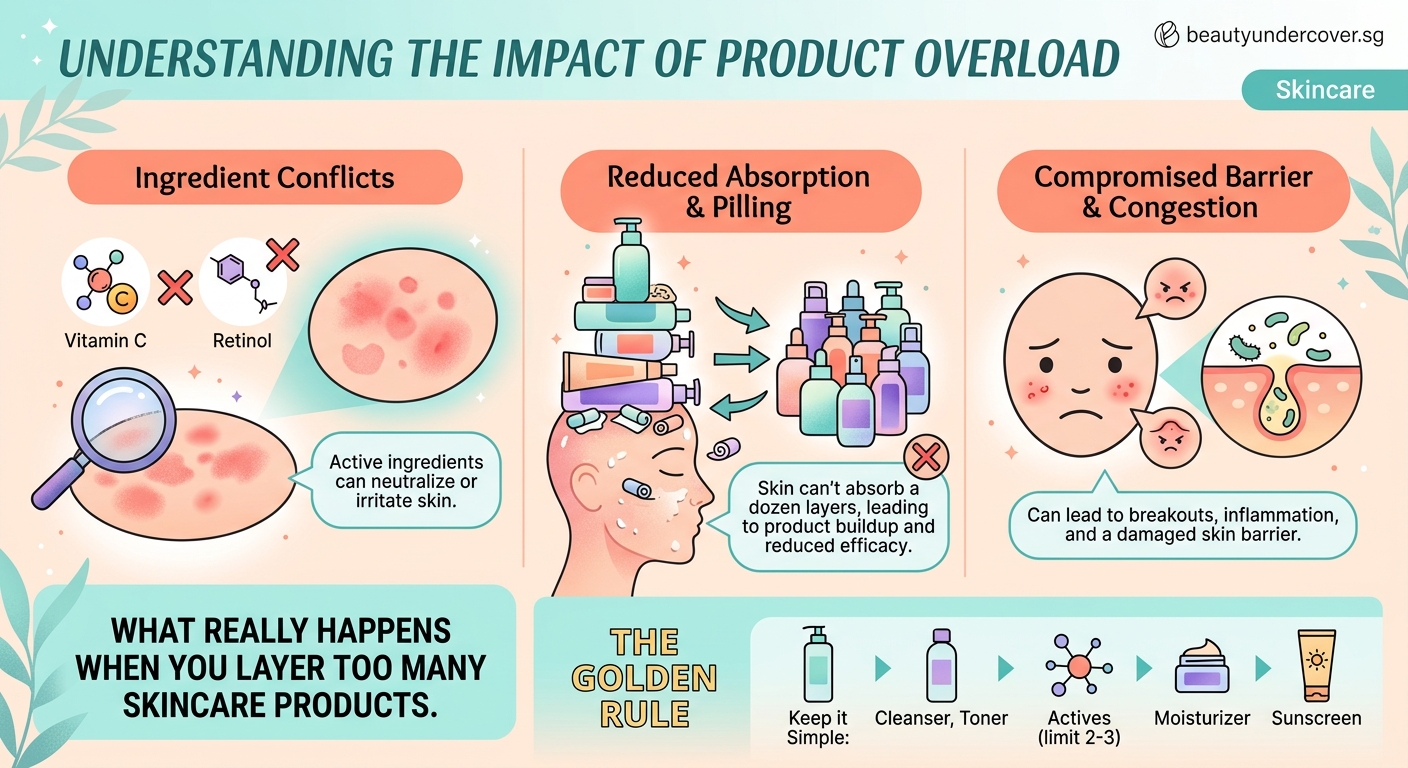
Each product you add increases the risk of ingredient conflicts. Niacinamide might not play well with vitamin C. Retinol can clash with AHAs. Peptides might cancel out certain actives.
Your skin gets confused. It doesn’t know what to do with all those competing signals.
The result? Redness, peeling, breakouts, and that tight, uncomfortable feeling that makes you want to skip skincare altogether.
Signs you’re using too many products
Your skin will tell you when enough is enough.
Here are the red flags:
- Persistent redness or flushing, especially after applying products
- Increased breakouts in areas where you normally don’t get them
- Tight, dry patches even though you’re using multiple hydrators
- Stinging or burning when you apply products that never bothered you before
- Tiny bumps or texture that won’t go away
- Makeup that pills or slides off within hours
- Products that never seem to fully absorb
- Skin that feels greasy but looks dehydrated
If you’re experiencing three or more of these symptoms, your routine is probably too complicated.
Your skin is essentially throwing up its hands and saying “I can’t process all of this.”
How product overload damages your skin
Layering too many skincare products creates a cascade of problems.
First, it disrupts your skin’s pH balance. Every product has a different pH level. When you stack seven or eight products, your skin can’t maintain its natural acidic mantle. That protective barrier becomes compromised.
Second, it prevents transepidermal water loss regulation. Your skin needs to breathe and release moisture naturally. Too many occlusive layers trap everything underneath, creating a breeding ground for bacteria and yeast overgrowth.
Third, it triggers inflammatory responses. Your immune system sees all those foreign ingredients as potential threats. It goes into overdrive trying to process everything, leading to chronic low-grade inflammation.
“Most of my patients who come in with ‘mystery’ skin issues are using 10+ products daily. When we strip their routine back to basics, their skin clears up within two to three weeks without adding anything new.” – Dr. Sarah Chen, Board-Certified Dermatologist
Fourth, it creates dependency. Your skin stops producing its own oils and protective factors because you’re constantly supplying them externally. When you try to simplify, your skin freaks out because it’s forgotten how to function normally.
The actual number of products you need
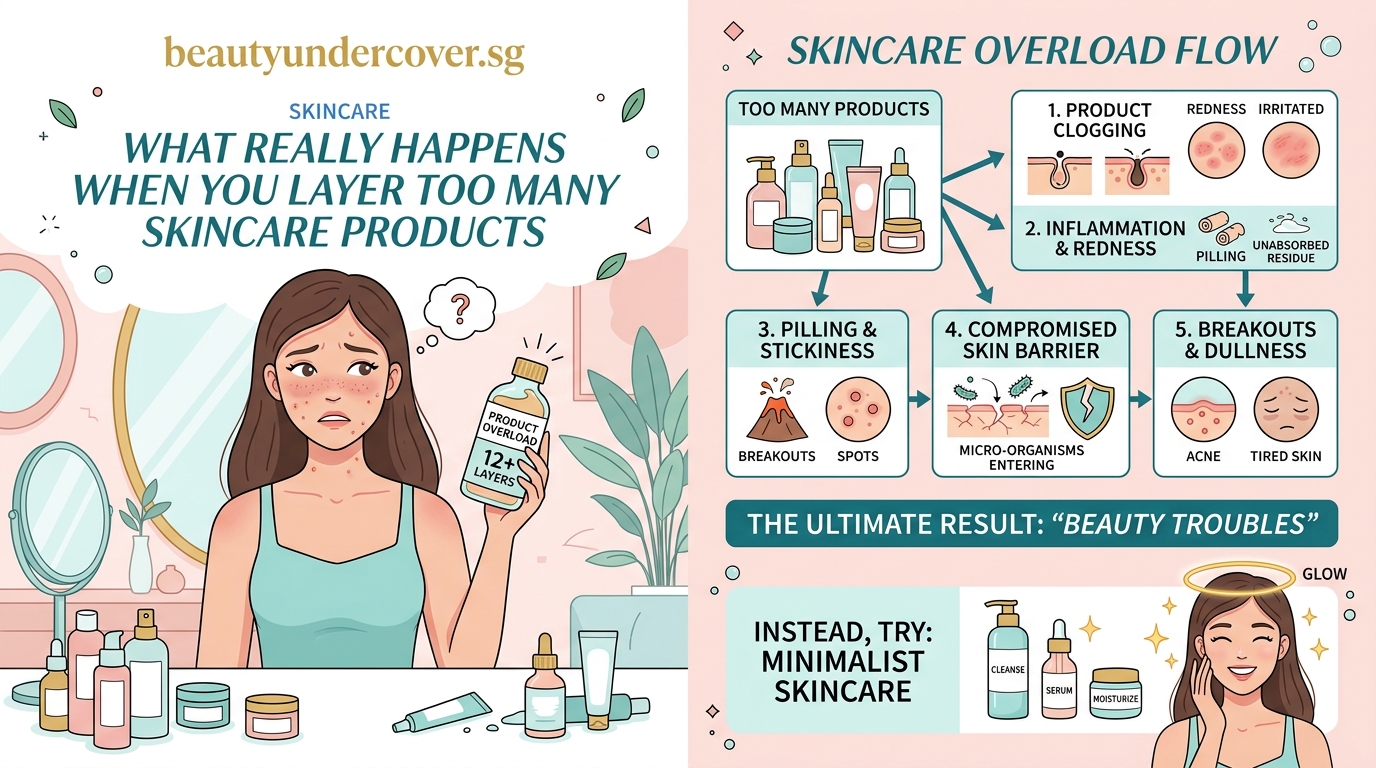
Most people need between four and six products total.
Not per routine. Total. For both morning and night combined.
Here’s what a functional routine looks like:
- Cleanser (one for morning, possibly a different one for night if you wear makeup)
- Treatment product (one active ingredient like retinol, vitamin C, or an acid)
- Moisturizer (could be the same for AM and PM, or different if needed)
- Sunscreen (morning only, obviously)
- Optional eye cream (if you have specific concerns that your face moisturizer doesn’t address)
- Optional targeted treatment (for specific issues like dark spots or acne)
That’s it.
Notice what’s missing? Toners, essences, ampoules, boosters, mists, sleeping masks, and the seventeen serums you thought you needed.
If you’re following how to build a simple 3-step skincare routine for absolute beginners, you already know that basic doesn’t mean ineffective.
What happens when you apply products in the wrong order
Even if you’re using the right number of products, wrong sequencing sabotages everything.
Thicker products create a barrier that prevents thinner ones from penetrating. If you apply your heavy cream before your lightweight serum, that serum is just sitting on top doing nothing.
Oil-based products repel water-based ones. Mix them up, and you’re watching your expensive hyaluronic acid serum bead up and roll off your face.
Certain ingredients need specific pH levels to work. If you apply a pH-dependent active like vitamin C after a high-pH product, you’ve just neutralized its effectiveness.
Here’s the correct order every single time:
| Step | Product Type | Why This Order Matters |
|---|---|---|
| 1 | Cleanser | Removes barriers to absorption |
| 2 | pH-adjusting toner (if using) | Preps skin for actives |
| 3 | Water-based serums | Thinnest consistency goes first |
| 4 | Oil-based serums | Heavier than water, lighter than cream |
| 5 | Eye cream | Targeted area needs less product |
| 6 | Moisturizer | Seals everything underneath |
| 7 | Sunscreen (AM only) | Final protective layer |
The rule is simple: thin to thick, water to oil, treatment to protection.
If you’re wondering about morning vs. night skincare: which products go when and why it matters, timing affects absorption just as much as order does.
The waiting time mistake everyone makes
You don’t need to wait 10 minutes between every product.
That TikTok trend is wasting your time and probably making things worse.
Most ingredients absorb within 30 to 60 seconds. If you’re waiting longer than that, you’re just letting products oxidize on your skin’s surface.
The exceptions:
- Retinol: Wait 20 minutes after cleansing to let your skin’s pH normalize. Applying retinol to damp skin increases irritation risk.
- Vitamin C: Wait 60 to 90 seconds for it to absorb and stabilize before layering anything on top.
- Chemical exfoliants: Give them two to three minutes to work at the right pH before neutralizing with other products.
- Sunscreen: Wait five minutes before makeup so it can form a proper film.
Everything else? Apply while the previous layer is still slightly damp. That actually helps with absorption.
Standing in your bathroom for 45 minutes every night isn’t self-care. It’s excessive, and your skin doesn’t benefit from it.
Common product combinations that backfire
Some ingredients should never meet on your face at the same time.
These combinations either cancel each other out or create irritation:
- Retinol + Vitamin C: Both are pH-sensitive and work at different levels. Use vitamin C in the morning, retinol at night.
- Niacinamide + Vitamin C: Old science said they fight. New science says they’re fine together, but if you have sensitive skin, separate them anyway.
- AHA/BHA + Retinol: Double exfoliation that strips your barrier. Pick one per routine, not both.
- Benzoyl peroxide + Retinol: Benzoyl peroxide oxidizes retinol, making it useless. Use BP in the morning, retinol at night.
- Multiple acids: Glycolic + salicylic + lactic acid in one routine is overkill. Your skin doesn’t need that much exfoliation.
Understanding how to layer vitamin C and AHAs without destroying your skin barrier can save you from months of damage control.
The goal isn’t to use everything you own. The goal is to use the right things that work together.
How to simplify without feeling like you’re giving up
Cutting products feels scary when you’ve invested time and money.
You worry your skin will fall apart without that seven-serum routine.
It won’t.
Here’s how to pare down without panic:
-
Stop everything except cleanser, moisturizer, and sunscreen for one week. Let your skin reset. Notice what actually happens. Spoiler: it probably improves.
-
Add back one active ingredient. Choose your biggest concern. Acne? Try a retinoid. Hyperpigmentation? Add vitamin C. Dryness? Use the best hydrating serums for dry skin under $30.
-
Wait two weeks before adding anything else. Give your skin time to adjust and show you whether that product actually works.
-
Add a second active only if you have a second distinct concern. Not because you bought it. Not because everyone’s talking about it. Only if you genuinely need it.
-
Evaluate after 30 days. Is your skin better than when you were using 12 products? Almost certainly yes.
The products you remove won’t go to waste. Give them to friends, donate them, or save them for later when your skin changes.
Your bathroom counter will thank you. Your skin will thank you. Your wallet will definitely thank you.
What to do if your skin freaks out when you simplify
Sometimes your skin gets worse before it gets better.
This doesn’t mean you should go back to your 10-step routine.
When you’ve been overloading your skin, it becomes dependent on external support. It stops regulating oil production, moisture retention, and barrier repair on its own.
Simplifying forces it to relearn those functions.
You might experience:
- Increased oiliness for the first week or two
- Temporary dryness as your skin adjusts
- Small breakouts as clogged pores finally clear out
- Slight sensitivity that resolves within days
This is different from why your skin purges when you start new products and what to do about it. You’re not introducing a new active. You’re removing obstacles.
Give it three weeks minimum before judging results.
If your skin is still angry after a month, you might have damaged your barrier. In that case, go even simpler: gentle cleanser, basic moisturizer, sunscreen. Nothing else until your barrier repairs itself.
No acids. No retinol. No actives of any kind.
Just protection and repair for four to six weeks.
The financial reality of product hoarding
Let’s talk about what layering too many skincare products actually costs.
Average skincare routine with 10+ products:
- Cleanser: $15 every two months
- Toner: $25 every two months
- Essence: $40 every six weeks
- Three serums: $90 every two months
- Eye cream: $35 every two months
- Moisturizer: $45 every six weeks
- Night cream: $50 every two months
- Face oil: $30 every two months
- Sleeping mask: $35 every month
- Sunscreen: $20 every month
That’s roughly $385 every two months, or $2,310 per year.
Simplified routine with four products:
- Cleanser: $15 every two months
- One treatment serum: $40 every two months
- Moisturizer: $30 every six weeks
- Sunscreen: $20 every month
That’s roughly $105 every two months, or $630 per year.
You’re saving $1,680 annually by using fewer, better products.
And your skin probably looks better too.
When more products actually make sense
Some situations genuinely require additional steps.
If you have active acne plus hyperpigmentation plus premature aging, you might need separate treatments for each concern. That could mean four to five products instead of three.
If you live in an extremely dry climate, you might need both a hydrating serum and a rich moisturizer.
If you have rosacea or eczema, you might need a barrier repair treatment in addition to your basic routine.
The difference? These are targeted solutions for specific, diagnosed conditions.
Not “I saw this product on Instagram and it looks pretty.”
Ask yourself: What specific problem does this product solve that my current routine doesn’t address?
If you can’t answer that clearly, you don’t need it.
How to know if a product is actually working
You’re using fewer products now. Good.
But how do you know if they’re working?
Give each product four to six weeks before judging effectiveness. Skin cell turnover takes about 28 days. You won’t see real results before then.
Track one specific metric:
- Acne treatments: Count your breakouts weekly
- Hydration products: Note how long your skin feels comfortable after applying
- Anti-aging: Take identical photos in the same lighting monthly
- Brightening: Compare hyperpigmentation spots to photos from week one
If you’re not seeing improvement by week six, the product isn’t working for you.
Doesn’t matter how many five-star reviews it has. Doesn’t matter if it worked miracles for your best friend.
If your skin isn’t responding, move on.
This is much easier to track when you’re using four products instead of fourteen. You actually know what’s doing what.
Building a routine that grows with your skin
Your skin changes.
Hormones shift. Seasons change. Stress levels fluctuate. Age happens.
A routine that worked perfectly at 28 might not work at 35. Winter skin needs different support than summer skin.
This is why having a minimal base routine matters.
When something changes, you know exactly what to adjust.
If you suddenly start breaking out, you’re not wondering which of your eight serums is the culprit. You know it’s either your cleanser, your one treatment product, or your moisturizer.
Easy to troubleshoot. Easy to fix.
Build your routine around these core principles:
- One gentle cleanser that removes dirt without stripping
- One active ingredient that addresses your primary concern
- One moisturizer that supports your barrier
- One sunscreen that you’ll actually wear daily
Everything else is optional and should be added only when you have a clear, specific reason.
Following the right order to apply your skincare products for maximum results matters more than how many products you own.
Why your skin doesn’t need that new launch
The beauty industry releases approximately 200 new skincare products every month.
They’re not doing that because your skin suddenly developed 200 new needs.
They’re doing it because they need you to keep buying.
Every product promises to be the missing piece in your routine. The one thing that will finally fix everything.
But here’s the truth: if you have clean skin, protected skin, and treated skin, you’re done.
That new peptide serum with “revolutionary technology” probably contains the same peptides as the serum you already own. Just in a prettier bottle with better marketing.
That limited-edition sleeping mask does the same thing as applying your regular moisturizer a little thicker.
That essence with “rare botanical extracts” is mostly water and glycerin, same as every other essence.
You don’t need it.
Your skin doesn’t need it.
What your skin needs is consistency with products that already work.
The minimalist approach that actually works
Skincare minimalism isn’t about deprivation.
It’s about intentionality.
It’s choosing four products that work synergistically instead of twelve products that fight each other.
It’s spending money on one excellent vitamin C serum instead of three mediocre ones.
It’s having time in your morning for coffee instead of a 30-minute skincare routine.
It’s knowing exactly what’s on your face and why it’s there.
When you stop layering too many skincare products, you give your skin room to do what it does naturally. You stop interfering with its built-in repair and regulation systems.
You become the support system, not the entire system.
Your skin remembers how to be skin. It produces the right amount of oil. It maintains its barrier. It heals faster because it’s not constantly inflamed from product overload.
And you save roughly $140 per month that you can spend on literally anything else.
Better skincare isn’t about more. It’s about right.
Start with less. Add only what you need. Let your skin breathe.
You might be surprised how good “simple” can look.