You’ve spent good money on that vitamin C serum, retinol treatment, and face oil. But if you’re slapping them on in the wrong order, you might as well be pouring them down the drain. The sequence matters more than you think. Apply products incorrectly and they’ll sit on your skin doing absolutely nothing, blocked by the wrong layer underneath.
The golden rule for skincare routine order is to apply products from thinnest to thickest consistency. Start with water-based serums, follow with treatments, then oils, and seal everything with moisturizer. This sequence ensures each product penetrates properly and delivers its active ingredients where they need to go. Sunscreen always goes last in the morning.
Why skincare routine order actually matters
Your skin isn’t a sponge that absorbs everything equally. Each product has a different molecular weight and texture. Heavier products create a barrier that prevents lighter ones from getting through.
Think of it like getting dressed. You put on your underwear before your jeans, not after. Same logic applies here.
Water-based products need direct contact with your skin to work. If you apply a thick cream first, that serum you bought can’t penetrate. It just sits on top, evaporating or rubbing off on your pillow.
The order also affects how products interact with each other. Some ingredients boost others. Some cancel each other out. Getting the sequence right means you actually see results instead of wondering why your expensive routine isn’t working.
The basic rule that solves most confusion
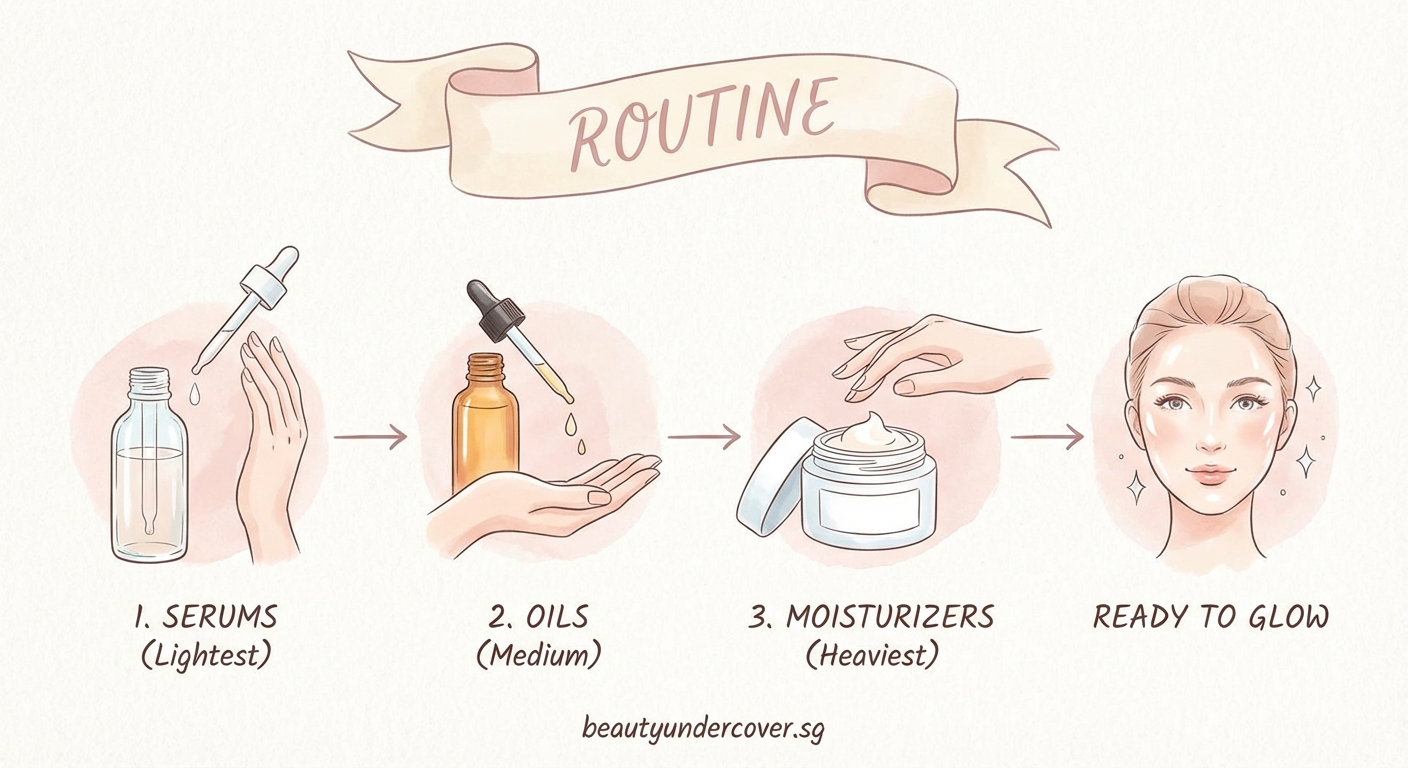
Here’s the framework that works for almost every product: thin to thick, water to oil.
Start with the most liquid consistency. End with the most occlusive (that means it creates a barrier).
Your skin can absorb watery products easily. Once you apply something oily or creamy, it creates a seal. Anything you put on after that seal won’t get through as effectively.
This rule handles about 90% of your products. The other 10% are special cases we’ll cover in a minute.
Morning skincare routine order step by step
Your morning routine protects your skin for the day ahead. Here’s the exact sequence:
- Cleanser – Wash away overnight oil and product buildup. Use lukewarm water, not hot.
- Toner or essence – These are the thinnest liquids in your routine. Pat them on while skin is still damp.
- Water-based serums – Vitamin C, niacinamide, hyaluronic acid. Apply from thinnest to thickest if you’re using multiple.
- Eye cream – The skin around your eyes is delicate. A small amount goes a long way.
- Treatments or spot treatments – Acne medication, dark spot correctors, anything targeted.
- Moisturizer – This locks in everything underneath and adds hydration.
- Face oil (optional) – If your skin is very dry, a few drops can go over moisturizer.
- Sunscreen – This is non-negotiable. SPF 30 minimum, every single day, even when it’s cloudy.
Wait about 30 seconds between steps. You don’t need to wait five minutes like some people claim. Just give each layer a moment to settle.
If you’re short on time, check out the ultimate 10-minute morning skincare routine for busy people to streamline this process.
Evening skincare routine order step by step
Nighttime is when your skin repairs itself. Your routine supports that process:
- First cleanse (if wearing makeup or sunscreen) – Use an oil-based cleanser or micellar water to break down makeup and SPF.
- Second cleanse – A regular cleanser to actually clean your skin. This is called double cleansing.
- Toner or essence – Same as morning. This preps your skin to absorb what comes next.
- Treatment serums – Retinol, peptides, or other active ingredients. Start with the thinnest.
- Eye cream – Nighttime formulas are often richer than daytime ones.
- Face oil or serum oil – If you use one, it typically goes here, before your final moisturizer.
- Night cream or moisturizer – Usually thicker than your morning moisturizer to prevent water loss while you sleep.
- Sleeping mask or occlusive (optional) – For extra dry skin, a final sealing layer keeps everything locked in.
Some people prefer oil after moisturizer. We’ll get to that debate in a second.
The great oil debate: before or after moisturizer
This confuses everyone. The answer depends on the type of oil and what you’re trying to achieve.
Oil before moisturizer works when:
– You’re using a lightweight facial oil (like squalane or rosehip)
– Your moisturizer is thick and creamy
– You want the oil’s active ingredients to penetrate
Oil after moisturizer works when:
– You’re using a heavy oil (like argan or marula)
– Your skin is extremely dry and needs a final seal
– You want the oil to lock everything in rather than penetrate
Most modern facial oils are designed to go before moisturizer. They’re formulated to absorb, not just sit on top. Check your product instructions. If it says “serum oil” or “treatment oil,” it goes before moisturizer.
If it’s a pure plant oil with no added ingredients, it probably goes after.
When in doubt, do the texture test. Thinner goes first.
How to layer multiple serums without wasting product
You bought three serums and now you don’t know how to use them all. Here’s how to layer them properly.
Apply in this order based on function:
- Hydrating serums first (hyaluronic acid, glycerin-based)
- Antioxidant serums second (vitamin C, vitamin E, ferulic acid)
- Treatment serums last (retinol, AHAs, BHAs, peptides)
Why this order? Hydrating serums prep your skin and help other products absorb better. Antioxidants protect. Treatments work on specific concerns and often need to be closest to your skin to be effective.
If you’re using acids (AHAs or BHAs), they typically go right after cleansing and toning, before other serums. Acids adjust your skin’s pH and work best on clean skin.
“The biggest mistake I see is people applying retinol over a thick cream. It can’t penetrate that barrier. Retinol needs direct contact with skin, or at most, a thin hydrating serum underneath.” – Licensed esthetician with 12 years experience
Don’t layer more than three serums at once. Your skin can only absorb so much. Rotate products instead. Use vitamin C in the morning, retinol at night. Save your peptide serum for days when you skip retinol.
Common mistakes that sabotage your routine
| Mistake | Why It’s a Problem | The Fix |
|---|---|---|
| Applying sunscreen before moisturizer | Sunscreen needs to form an even film on top of everything to protect properly | Always make sunscreen your final morning step |
| Using retinol in the morning | Retinol breaks down in sunlight and becomes less effective | Save retinol for nighttime only |
| Mixing vitamin C with retinol | Can cause irritation and reduce effectiveness of both | Use vitamin C in the morning, retinol at night |
| Applying products to bone-dry skin | Products absorb better on slightly damp skin | Pat in serums while skin is still a bit damp from cleansing |
| Rubbing products in aggressively | Tugging damages skin and doesn’t improve absorption | Press and pat products in gently |
| Using too much product | More isn’t better; excess just sits on top | A pea-sized amount covers your whole face for most products |
Another mistake? Changing your entire routine every week. Your skin needs at least 28 days (one full skin cell turnover cycle) to show results from new products. Give things time to work.
Special cases and tricky products
Some products don’t follow the thin-to-thick rule. Here’s how to handle them:
Prescription treatments – Follow your dermatologist’s instructions exactly. Some prescriptions need to go on clean, dry skin with nothing underneath. Others work better with a buffer layer.
Exfoliating acids – These go right after cleansing, before toner. Your skin needs to be at the right pH for them to work. Wait about 2-3 minutes after applying before moving to the next step.
Sheet masks – Use these after cleansing and toning but before serums. The essence from the mask counts as a serum step. Pat in any remaining essence, then continue with your routine.
Sunscreen with tint or color – This goes last, after your regular sunscreen if you’re layering. Or skip regular sunscreen and just use the tinted one as your sole SPF.
Makeup primers – These go after sunscreen. Think of primer as the bridge between skincare and makeup.
If you’re looking to create a more streamlined approach, how to build a simple 3-step skincare routine for absolute beginners breaks down the essentials.
How to know if your routine order is working
Your skin will tell you if you’ve got the sequence right. Here’s what to look for:
Good signs:
– Products absorb within a minute or two
– No pilling (when products ball up on your skin)
– Skin feels smooth, not sticky or greasy
– You’re seeing gradual improvement in your skin concerns
– Makeup applies smoothly if you wear it
Bad signs:
– Products sit on top of your skin for ages
– You get little balls of product when you rub your face
– Your face feels like it has a thick film on it
– You’re breaking out more than usual
– Products sting or burn when they didn’t before
If you’re seeing bad signs, the order is probably off. Or you’re using too much product. Try cutting the amount in half and see if that helps.
Sometimes products just don’t play well together, even in the right order. If you’ve tried adjusting the sequence and amounts and still have issues, you might need to use certain products on alternating days instead of layering them.
Adjusting your routine order for different skin types
The basic sequence stays the same, but you might emphasize different steps:
For oily skin:
– Skip heavy creams
– Use lightweight serums and gel moisturizers
– Oil-free sunscreen only
– You might skip face oils entirely
For dry skin:
– Layer multiple hydrating products
– Use richer creams
– Face oil is your friend (use it before moisturizer)
– Consider an occlusive final step at night
For sensitive skin:
– Fewer products mean fewer chances for irritation
– Stick to fragrance-free formulas
– Introduce new products one at a time
– Wait longer between steps to ensure nothing stings
For combination skin:
– You might need to use different products on different areas
– Lighter products on your T-zone, richer on your cheeks
– This takes more time but gets better results
Your skin type might change with seasons too. You might need heavier products in winter and lighter ones in summer. Pay attention and adjust.
Building your perfect sequence
Start simple. You don’t need ten products to have great skin. A solid routine can be as few as four products: cleanser, one serum, moisturizer, and sunscreen.
Add products one at a time. Wait two weeks before adding the next one. This way, if something breaks you out or irritates your skin, you know exactly what caused it.
Write down your routine. Seriously. Keep a note on your phone with your exact morning and evening sequences. When you’re half asleep at 11 PM, you don’t want to stand there trying to remember if the peptide serum goes before or after the hyaluronic acid.
Take photos. Not for social media, for yourself. Monthly photos in the same lighting help you see if your routine is actually working. Progress is gradual and easy to miss day to day.
If you want to add some luxury without spending a fortune, how to build a luxury skincare routine without breaking the bank shows you how to choose wisely.
Products that can mess up your whole routine
Some ingredients don’t play well with others. Using them together, even in the right order, causes problems:
- Retinol + vitamin C – Use at different times of day
- Retinol + AHAs/BHAs – Too much exfoliation; alternate nights
- Vitamin C + niacinamide – This is actually fine despite old myths, but some people get flushing
- Benzoyl peroxide + retinol – Can deactivate each other; use at different times
- Multiple acids at once – One acid at a time unless you have very tough skin
When you add a new active ingredient, reduce or pause other actives for a week. Your skin needs time to adjust.
Getting the timing right between steps
You don’t need to wait forever between products. Here’s what actually matters:
30 seconds to 1 minute is enough for most products. They don’t need to be completely dry. Slightly damp skin actually helps the next product spread better.
2 to 3 minutes after applying acids or retinol. These products need time to work at the right pH before you buffer them with other products.
5 minutes after sunscreen before makeup. This gives sunscreen time to set properly so it doesn’t pill under foundation.
15 to 20 minutes after applying retinol if your skin is sensitive. This wait time reduces irritation.
Some people prefer to do their routine in stages. Apply your serums, then brush your teeth. Come back and apply moisturizer and sunscreen. This natural spacing can work better than standing in front of the mirror for ten minutes straight.
Your routine should work for your life
The perfect skincare routine order means nothing if you won’t actually do it. Be realistic about what you’ll stick with.
If you’re not a morning person, keep your AM routine super simple. Save the elaborate multi-step routine for evening when you have more time and patience.
If you travel a lot, create a simplified travel version. Three to four products that cover the basics. You can go back to your full routine when you’re home.
If you have kids who barge into the bathroom every 30 seconds, do your routine after they’re in bed. Or wake up 10 minutes earlier. Find what works for your actual life, not the life you wish you had.
The best routine is the one you’ll do consistently. Five products applied in the right order every day beats 12 products applied randomly when you remember.
Making your products work harder for you
Now that you know the right skincare routine order, your products will finally deliver the results they promise. No more wondering why that expensive serum isn’t doing anything. No more pilling under your sunscreen. No more confusion about whether the oil goes before or after the cream.
Start with the sequence that makes sense for your current products. Pay attention to how your skin responds. Adjust as needed. Take it one step at a time, and remember that consistency matters more than perfection. Your skin will thank you for getting the order right.