You’ve invested in a vitamin C serum for brightness and an AHA exfoliant for smooth texture. Now they’re both sitting on your bathroom counter, and you’re wondering if using them together will give you glowing skin or a red, angry mess.
The short answer? Yes, you can use vitamin C and AHA together, but timing and technique matter more than you think.
You can safely combine vitamin C and AHA in your routine by separating them by time or alternating days. Both ingredients work at low pH levels and can cause irritation when layered directly. Start slowly, monitor your skin’s response, and always follow with sunscreen during the day to protect newly exfoliated skin from UV damage.
Understanding Why These Ingredients Are Tricky Together
Vitamin C (ascorbic acid) and AHAs (like glycolic or lactic acid) are both pH-dependent actives.
They work best in acidic environments, typically between pH 3 and 4.
When you layer them together without proper spacing, you’re essentially doubling down on acidity. Your skin barrier gets overwhelmed trying to handle both at once.
Think of it like adding lemon juice and vinegar to the same dish. Both are acidic, both have benefits, but together they can overpower everything else.
The result? Redness, stinging, flaking, and potential barrier damage that takes weeks to repair.
But here’s the thing: when used strategically, these two can actually complement each other beautifully. AHAs clear away dead skin cells, allowing vitamin C to penetrate more effectively and work its brightening magic.
The Science Behind the Sensitivity
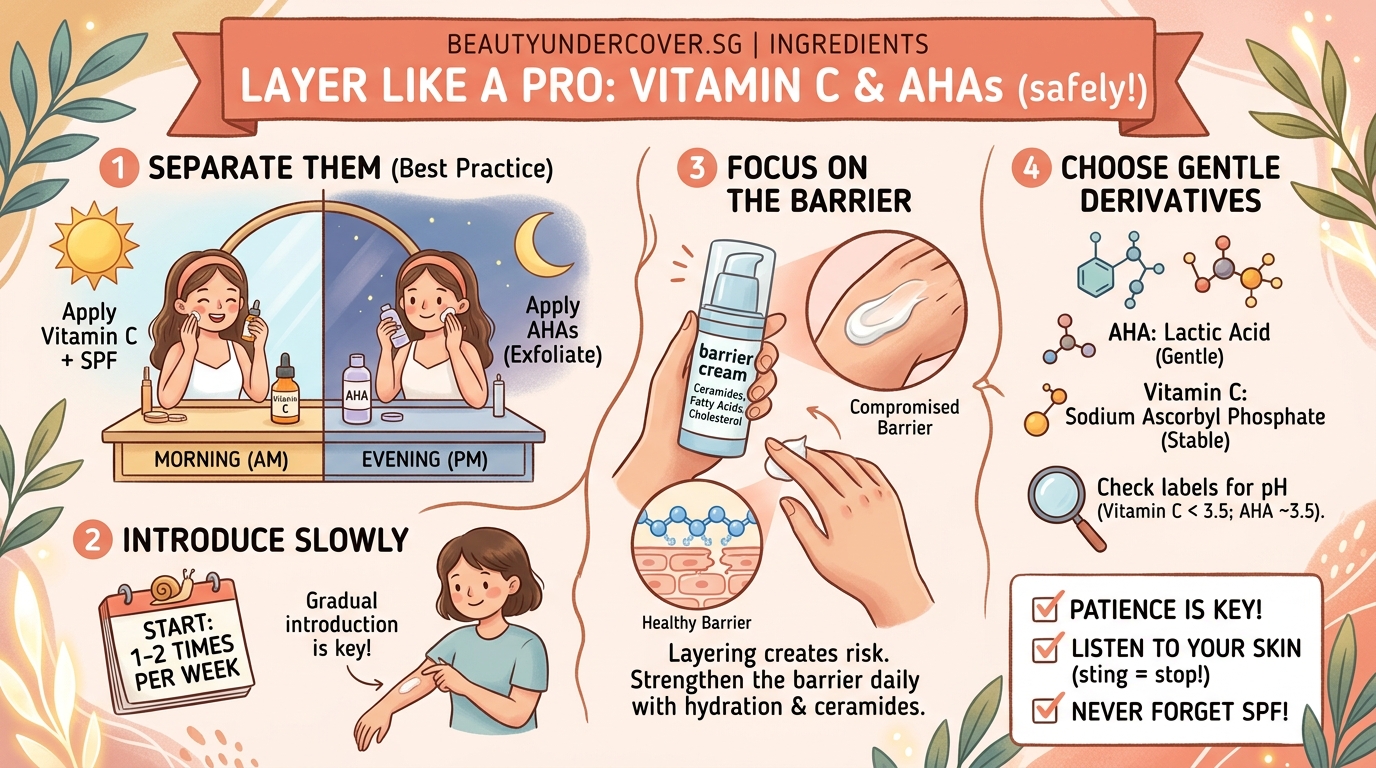
AHAs work by loosening the bonds between dead skin cells on your skin’s surface.
This exfoliation process temporarily makes your skin more permeable and slightly more vulnerable.
Vitamin C, particularly L-ascorbic acid, needs to be formulated at a low pH (around 3.5 or lower) to remain stable and penetrate the skin effectively.
When you apply both ingredients close together, you’re asking your skin to process two potent acids simultaneously. Your skin’s natural pH is around 4.5 to 5.5, and these products push it much lower.
For some people, this causes immediate tingling or burning. For others, the irritation builds gradually over days or weeks until they notice persistent dryness and sensitivity.
“The key isn’t avoiding these combinations entirely, but understanding how to introduce them in a way that respects your skin barrier’s capacity to adapt and recover.” — Board-certified dermatologist Dr. Michelle Henry
Three Safe Ways to Combine Vitamin C and AHA
Here are the most effective strategies for using both ingredients without destroying your skin barrier.
Strategy 1: Time Separation Within the Same Day
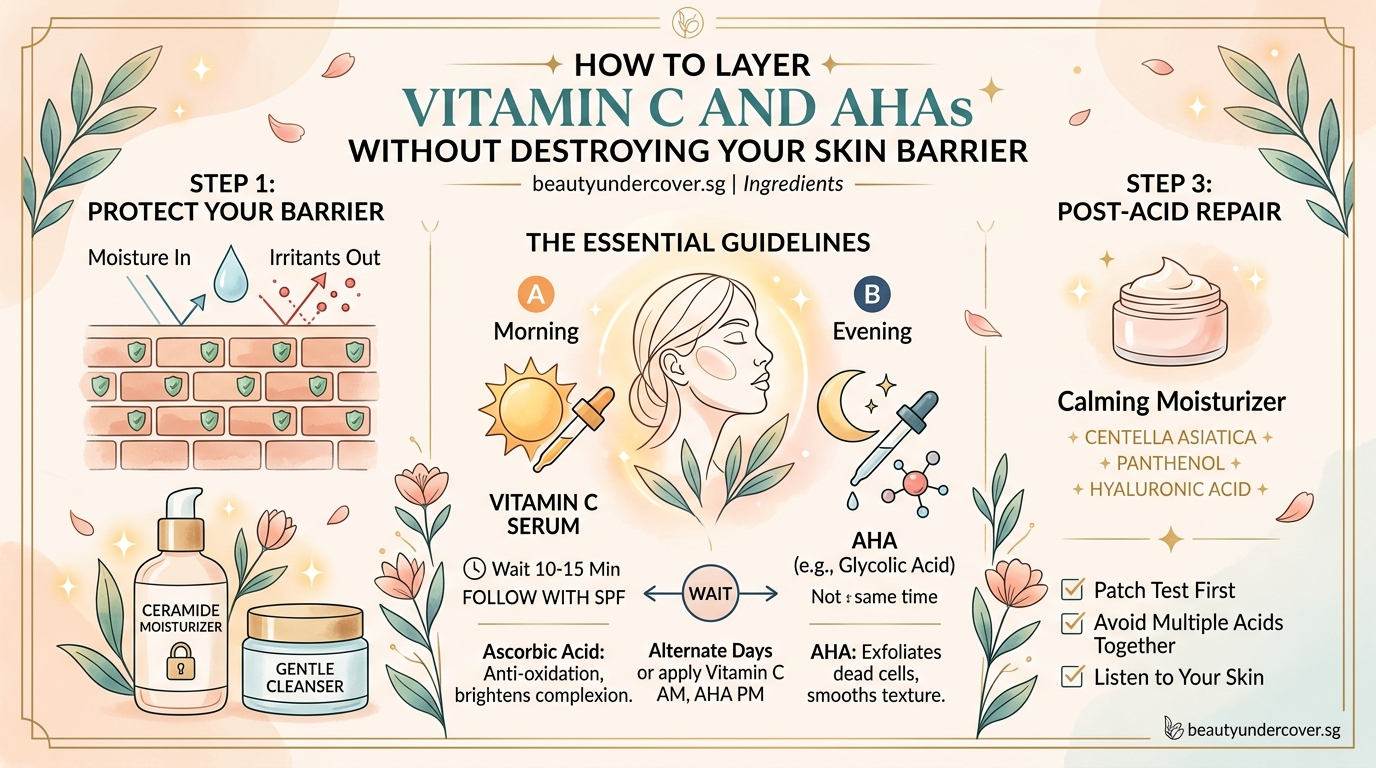
Apply vitamin C in the morning and AHA at night.
This gives each ingredient dedicated time to work without competing for absorption or overwhelming your skin.
Morning routine:
1. Cleanse with a gentle, pH-balanced cleanser
2. Apply vitamin C serum to dry skin
3. Wait 10-15 minutes for full absorption
4. Follow with hydrating serum if needed
5. Apply moisturizer
6. Finish with broad-spectrum SPF 30 or higher
Evening routine:
1. Double cleanse to remove sunscreen and makeup
2. Apply AHA toner or serum to dry skin
3. Wait 10-15 minutes
4. Layer on hydrating products
5. Seal with a richer night cream
This approach works well if you’re already comfortable with both ingredients individually and your skin tolerates daily active use.
Strategy 2: Alternating Days
Use vitamin C one day and AHA the next.
This method gives your skin a full 24 hours to recover between acid applications.
It’s particularly helpful if you’re just starting to build tolerance or if you have sensitive or reactive skin.
Sample weekly schedule:
| Day | Morning | Evening |
|---|---|---|
| Monday | Vitamin C + SPF | Gentle routine |
| Tuesday | Basic routine + SPF | AHA treatment |
| Wednesday | Vitamin C + SPF | Gentle routine |
| Thursday | Basic routine + SPF | AHA treatment |
| Friday | Vitamin C + SPF | Gentle routine |
| Saturday | Basic routine + SPF | AHA treatment |
| Sunday | Vitamin C + SPF | Recovery night (extra hydration) |
Strategy 3: Different Concentrations and Formulations
Choose gentler versions of one or both products.
Instead of 20% L-ascorbic acid, try 10% or switch to a more stable derivative like sodium ascorbyl phosphate or magnesium ascorbyl phosphate.
For AHAs, start with lactic acid (gentler than glycolic) at 5% concentration rather than jumping to 10% or higher.
Derivative forms of vitamin C are typically formulated at higher pH levels (around 5-7), which means less potential for irritation when combined with AHAs.
Signs You’re Overdoing It
Your skin will tell you when it’s had enough. Watch for these warning signals:
- Persistent redness that doesn’t fade within 30 minutes of application
- Burning or stinging that feels more intense than a mild tingle
- Dry, flaky patches appearing in new areas
- Increased sensitivity to products that never bothered you before
- Breakouts in unusual patterns (often a sign of barrier disruption)
- Tightness that doesn’t improve even after moisturizing
- Shiny, almost plastic-looking skin texture (sign of over-exfoliation)
If you notice any of these symptoms, scale back immediately. Your skin barrier needs time to rebuild.
Take a break from both actives for at least a week. Focus on gentle cleansing, simple moisturizing, and barrier-repair ingredients like ceramides and centella asiatica.
Once your skin feels normal again, reintroduce one active at a time, starting with just twice per week.
Building Tolerance the Right Way
If you’re new to either vitamin C or AHA, don’t start both at the same time.
Introduce one active first, use it consistently for 4-6 weeks, then add the second.
This way, if you experience irritation, you’ll know exactly which product is causing the problem.
Start frequency:
1. Week 1-2: Use new active twice per week
2. Week 3-4: Increase to every other day if skin tolerates well
3. Week 5-6: Move to daily use if desired and tolerated
4. Then introduce second active following the same progression
When you’re just starting to build a skincare routine, patience pays off more than aggressive treatment schedules.
The Buffer Method for Extra Sensitive Skin
If your skin is particularly reactive, try the buffer technique.
Apply a thin layer of lightweight moisturizer before your active ingredients. This creates a protective cushion that slows absorption slightly and reduces irritation potential.
You’ll still get benefits from your vitamin C and AHA, just with less risk of overwhelming your skin.
The trade-off is slightly reduced potency, but that’s better than damaging your barrier and having to stop using actives entirely.
Product Texture Matters More Than You Think
The order you apply products affects how well they work together.
General layering rule: thinnest to thickest consistency.
Apply watery toners and serums first, then creams and oils last.
If you’re using both vitamin C and AHA in the same routine (morning and night separation), this becomes especially important.
Water-based vitamin C serums should go on clean, dry skin before any moisturizing products. AHA toners work best on freshly cleansed skin as well.
Never apply acids over occlusives like petroleum jelly or heavy oils. They create a barrier that prevents proper penetration and can trap irritating ingredients against your skin.
Common Mistakes That Sabotage Your Results
These errors can turn a potentially beneficial combination into a skin disaster:
- Skipping sunscreen after using either ingredient
- Not waiting between product applications
- Using harsh, high-pH cleansers that disrupt your starting point
- Adding other actives like retinol without adjusting frequency
- Ignoring your skin’s feedback and pushing through irritation
- Using products that are too strong for your current tolerance level
- Forgetting that physical exfoliation and AHAs shouldn’t happen on the same day
Many people also make the mistake of thinking more is better. If 10% vitamin C is good, 20% must be twice as good, right?
Not necessarily. Higher concentrations increase irritation risk without always delivering proportionally better results.
What to Pair With Your Vitamin C and AHA Routine
Support your active ingredients with complementary products that protect and strengthen your skin barrier.
Essential additions:
- Niacinamide (use at different times from vitamin C if using L-ascorbic acid)
- Hyaluronic acid for hydration
- Ceramides to reinforce barrier function
- Centella asiatica for soothing and repair
- Broad-spectrum mineral sunscreen for daytime protection
Avoid combining with:
- Retinol on the same nights as AHA (alternate instead)
- Benzoyl peroxide in the same routine as vitamin C (can oxidize it)
- Physical scrubs or brushes on days you use AHA
- Other strong acids like salicylic acid without adjusting frequency
When you’re figuring out which products go when, remember that strategic timing prevents most compatibility issues.
Adjusting for Your Skin Type
Different skin types need different approaches to combining these actives.
Oily or acne-prone skin: Can typically handle more frequent acid use. You might do well with daily vitamin C in the morning and AHA 3-4 times per week at night.
Dry or mature skin: Needs more recovery time between treatments. Try vitamin C 4-5 times per week and AHA just 1-2 times per week, always followed by rich moisturizers.
Sensitive or reactive skin: Should start with the gentlest formulations and longest intervals. Consider using vitamin C derivatives and lactic acid (the mildest AHA), each just twice per week on alternating days.
Combination skin: Can use vitamin C daily but might need to apply AHA only to specific zones (like the T-zone) rather than all over.
When You Might Experience Purging
Starting AHAs can trigger a purging period where underlying congestion comes to the surface faster.
This is different from irritation.
Purging happens in areas where you typically break out and should resolve within 4-6 weeks as your skin cell turnover normalizes.
Irritation, on the other hand, appears as redness, burning, and dryness in areas that don’t usually have problems.
Vitamin C doesn’t typically cause purging, but it can cause irritation if your formulation is too strong or if you’re using it too frequently alongside other actives.
If you’re experiencing both purging from AHA and irritation from combining it with vitamin C, scale back to give your skin a fighting chance to adjust to one thing at a time.
The Role of pH in Your Routine
Understanding pH helps you make smarter decisions about product layering.
After cleansing, your skin’s pH rises slightly. Applying a pH-adjusting toner (around pH 4-5) before your actives helps them work more effectively.
However, if you’re using both vitamin C and AHA in close succession, you might be pushing your skin’s pH too low for too long.
Some people find that using a pH-adjusting toner before morning vitamin C works well, but skipping it before evening AHA (and just applying to cleansed skin) reduces overall acidity exposure.
There’s no one-size-fits-all answer here. Pay attention to how your skin responds and adjust accordingly.
Seasonal Adjustments Worth Considering
Your skin’s tolerance changes with weather and environmental conditions.
Summer considerations:
– Your skin may be more sensitive due to sun exposure
– Increased sweating can affect product absorption
– You might need to reduce frequency of both actives
– Sunscreen becomes even more critical
Winter considerations:
– Dry air compromises barrier function
– You may need to add more hydrating steps between actives
– Reduced sun exposure might allow for slightly more frequent active use
– But indoor heating can increase sensitivity
Transition periods (spring and fall) are often the best times to introduce new actives or increase frequency, as your skin isn’t dealing with extreme temperature or humidity changes.
Real Talk About Results and Timelines
Both vitamin C and AHA deliver visible improvements, but not overnight.
Vitamin C typically shows brightening effects within 4-8 weeks of consistent use. You might notice a more even tone and reduced appearance of dark spots.
AHAs improve texture and smoothness within 2-4 weeks, with continued improvement in fine lines and overall radiance over several months.
When used together strategically, these timelines can overlap and potentially accelerate, but only if you maintain consistency without overdoing it.
Damaging your barrier by being too aggressive will set you back weeks or months as you recover.
Making These Ingredients Work for Your Life
The “perfect” routine on paper means nothing if you can’t maintain it in real life.
If you travel frequently, you might prefer the alternating-days method because it’s easier to remember and requires less precise timing.
If you have a hectic morning routine, maybe evening AHA and skipping morning vitamin C on busy days makes more sense.
If you’re building out your nighttime routine, remember that consistency matters more than perfection.
Using vitamin C five days a week and AHA twice a week is better than planning to use both daily and then giving up after a week because it’s too complicated.
Finding the Right Balance for Lasting Results
Can you use vitamin C and AHA together? Absolutely.
But the real question is how to do it in a way that respects your skin’s limits while still getting the benefits you’re after.
Start conservatively, pay attention to your skin’s feedback, and adjust based on what you observe rather than what you think should work.
Your skin is unique, and what works for someone else might not work for you. That’s not a failure, it’s just information that helps you refine your approach.
Give yourself permission to experiment within safe boundaries, and remember that skincare is a marathon, not a sprint. The goal is healthy, resilient skin that looks better year after year, not dramatic results that come with lasting damage.