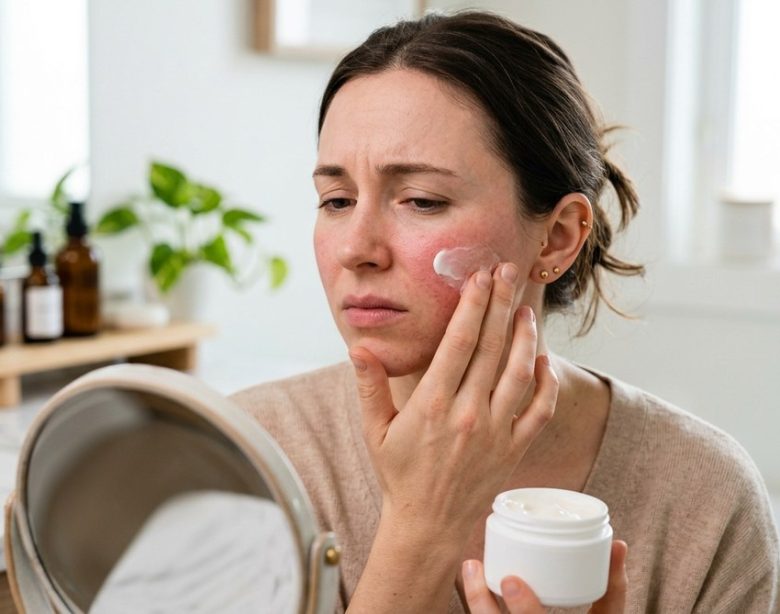
You smooth on your favorite moisturizer and expect that familiar feeling of comfort. Instead, a sharp sting radiates across your cheeks. Your skin turns pink. You wince and wonder if this is normal or a sign that something is wrong.
It is not normal. And your skin is trying to tell you something important.
When moisturizer stings, it usually points to a damaged skin barrier. This can happen after over-exfoliating, using too many active ingredients, or reacting to a specific component like fragrance or essential oils. The fix is not to stop moisturizing. It is to strip back your routine, choose barrier-repairing ingredients, and give your skin time to heal. This guide explains exactly what to do.
The Real Reason Your Moisturizer Burns
Your skin barrier is the outermost layer of your epidermis. Think of it like a brick wall. The skin cells are the bricks, and the lipids (ceramides, cholesterol, fatty acids) are the mortar. When that mortar is intact, your skin feels calm and holds onto moisture. When it gets weak or develops cracks, everything changes.
A compromised barrier allows ingredients to penetrate deeper than they should. That includes ingredients that are normally harmless. They reach nerve endings and trigger that burning or stinging sensation. So the sting is not necessarily proof that the product is bad. It is proof that your barrier is struggling to keep things out.
Many people assume the tingling means the product is “working.” In rare cases, a mild tingle from a pH-adjusted active like a vitamin C serum might be expected. But with a basic moisturizer? No. That is a red flag.
“If your moisturizer stings, your skin is telling you the barrier is impaired. Stop and reassess before you cause more inflammation.” — Dr. Marisa K. Thompson, board-certified dermatologist
The Most Common Causes Behind the Sting
Let’s break down why this happens so you can figure out which category you fall into.
1. Over-Exfoliation and Active Overload
This is the number one culprit. You might be using a retinoid at night, a salicylic acid cleanser in the morning, and a vitamin C serum before sunscreen. On paper, that sounds like a powerhouse routine. In reality, it is a recipe for a broken barrier.
When you strip the skin of its natural oils too often, the lipid layer thins out. Your face loses its ability to buffer ingredients. Even a gentle moisturizer can suddenly feel like acid on your skin.
2. Sensitivity to Specific Ingredients
Some ingredients are known irritants even for healthy skin. They are even more problematic when your barrier is down.
- Fragrance (both synthetic and natural essential oils)
- Denatured alcohol (often listed as Alcohol Denat.)
- Certain preservatives like methylisothiazolinone
- Menthol or peppermint oil (common in “cooling” formulas)
- High concentrations of AHAs or BHAs in leave-on products
If you recently switched to a moisturizer with a strong scent or a “tingly” feel, your skin may be reacting to the fragrance itself.
3. Extremely Dry or Dehydrated Skin
Dryness alone can cause stinging. When your skin is parched, the stratum corneum develops microfissures. Water-based moisturizers can slip into those tiny cracks and hit raw nerve endings. This is why some people feel a burn when they apply a hydrating gel after washing their face.
4. Recent Use of Strong Prescription Treatments
Tretinoin, adapalene, and prescription-strength azelaic acid are common offenders. These treatments speed up cell turnover and thin the top layer of skin temporarily. If you apply a moisturizer right after your retinoid, you might feel a sting because the barrier is in a vulnerable state.
5. An Allergic Reaction or Contact Dermatitis
Sometimes the sting is not just irritation. It is an allergy. If the stinging is accompanied by swelling, hives, or persistent redness, you may be allergic to an ingredient. Common allergens include propylene glycol, lanolin, and certain botanical extracts.
Should You Stop Using the Moisturizer?
This depends on the type of sting.
| Situation | What It Likely Means | What to Do |
|---|---|---|
| Sting lasts 10 seconds then fades | Mild barrier weakness | Keep using but simplify your routine |
| Sting persists for minutes | Moderate barrier damage | Stop the product and switch to a repair balm |
| Sting plus redness, swelling, or bumps | Possible allergic reaction | Stop immediately and consult a dermatologist |
| Sting only on broken skin (around acne or cuts) | Normal for damaged areas | Use a gentler formula until skin heals |
If the sting is mild and temporary, you can keep moisturizing. But you must address the underlying cause. If the sting is strong or does not go away, stop using that product. Your skin is not being dramatic. It is injured.
How to Fix Your Routine When Moisturizer Stings
Follow these steps in order. Do not skip ahead.
-
Stop all active ingredients for 5 to 7 days. That means no retinol, no acids, no vitamin C, no exfoliating scrubs. Give your barrier a break.
-
Switch to a minimalist cleanser. Use a non-foaming, creamy cleanser without sulfates. Your face should not feel tight or squeaky after washing.
-
Apply a barrier-repair moisturizer. Look for ingredients like ceramides, panthenol, shea butter, squalane, and colloidal oatmeal. Avoid fragrance and essential oils.
-
Add a protective layer at night. A thin layer of petrolatum or a zinc oxide balm can seal in moisture and speed up healing. This is sometimes called “slugging,” and it works.
-
Reintroduce actives slowly. After one week, add back one product at a time. Wait three days before adding another. If the sting returns, you know that product is the problem.
For a deeper look at building a safe routine from scratch, read our guide on how to build a simple 3-step skincare routine for absolute beginners.
Ingredients That Help a Damaged Barrier Heal
Not all moisturizers are created equal. When your skin stings, you need specific ingredients that mimic your skin’s natural lipids.
- Ceramides: These are the building blocks of your barrier. They fill in the gaps between skin cells.
- Panthenol (Pro-Vitamin B5): A humectant that also soothes inflammation and supports healing.
- Niacinamide: Helps boost ceramide production and reduces redness over time. Learn more about what does niacinamide really do for your skin.
- Squalane: An oil that closely resembles your skin’s own sebum. It is lightweight and non-irritating.
- Colloidal Oatmeal: Forms a protective film on the skin and calms itchiness and stinging.
- Zinc Oxide: Often found in diaper rash creams, it is incredibly soothing for compromised skin.
Ingredients to Avoid While Your Barrier Recovers
- Fragrance (listed as “parfum” or “fragrance”)
- Essential oils (lavender, tea tree, peppermint, eucalyptus)
- Denatured alcohol
- High-concentration AHAs and BHAs
- Sulfates in cleansers
If you are unsure how to spot these on a label, check out our ultimate guide to ceramides for a full breakdown of ingredient lists.
Can You Prevent the Sting From Happening Again?
Yes. Once your barrier is healthy, you can maintain it with a few habits.
- Do not wash your face more than twice a day. Over-washing strips natural oils.
- Use lukewarm water. Hot water damages the lipid layer.
- Apply moisturizer to damp skin. This locks in hydration and reduces the chance of stinging.
- Patch test new products on your jawline for three days before using them on your whole face.
- Rotate active ingredients instead of layering them. For example, use retinol on Monday and Wednesday, and acids on Friday. Learn more about how to layer your nighttime skincare products in the correct order.
When to See a Professional
If the stinging does not improve after two weeks of barrier repair, or if you develop persistent redness, flaking, or pain, see a dermatologist. You may have underlying conditions like rosacea, perioral dermatitis, or eczema that require prescription treatment.
Also see a professional if you suspect an allergic reaction. They can perform patch testing to identify the exact trigger.
Your Skin Is Not Broken, It Is Just Talking to You
A stinging moisturizer is not the end of the world. It is a signal. Your skin is asking for a break, not for you to abandon hydration altogether. The worst thing you can do is stop moisturizing completely. Dry skin only makes the problem worse.
Keep it simple. Use gentle products. Give your barrier time to rebuild. In a week or two, you will be able to apply your moisturizer without flinching. And that feeling of calm, comfortable skin? That is what a healthy barrier feels like.
If you want to understand more about why certain products cause reactions, read our article on why your skin purges when you start new products and what to do about it. It will help you tell the difference between purging, irritation, and an allergic response.
Your skin is smart. Listen to it.