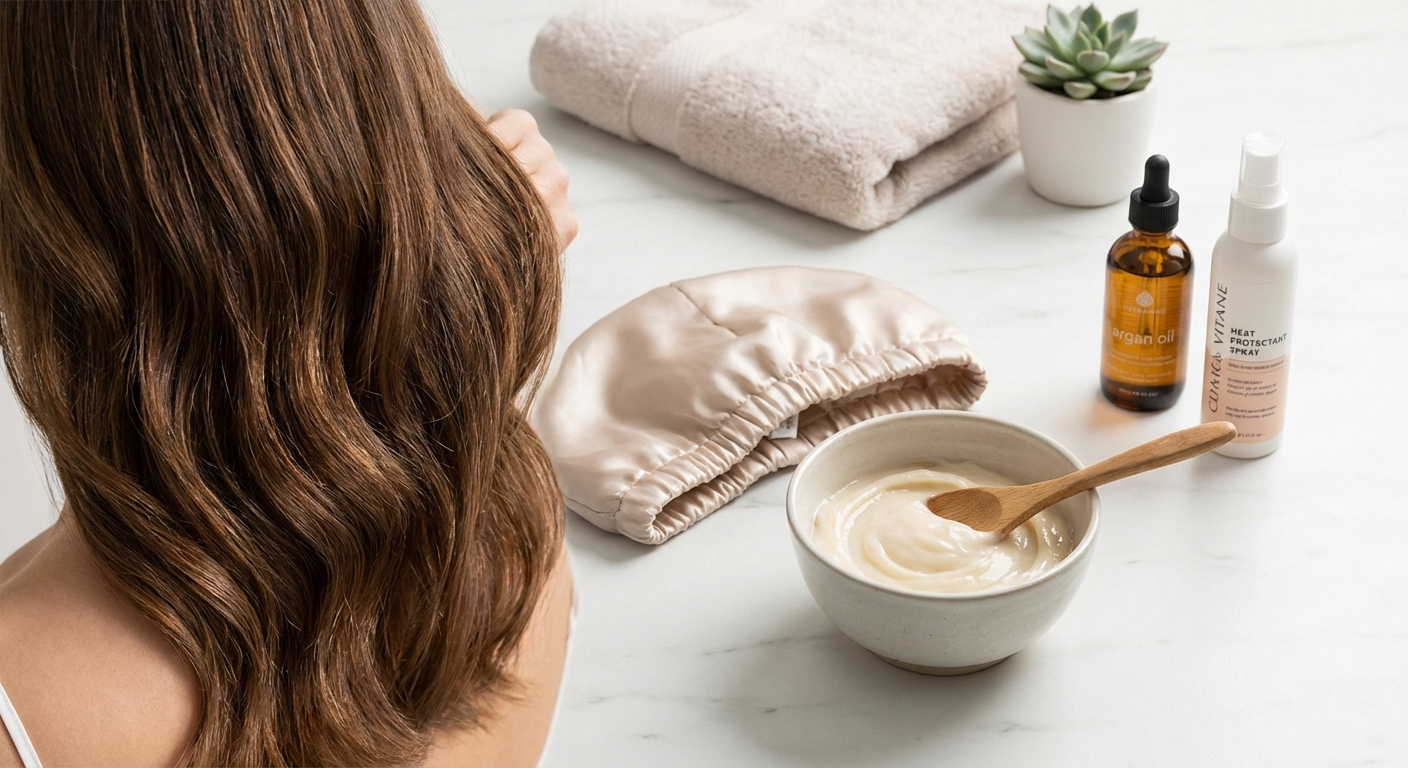
You’ve been reaching for that flat iron every morning for months. Maybe years. Now your hair feels like straw, snaps when you brush it, and the ends look frayed no matter how much serum you slather on.
The good news? You don’t need to book an emergency salon appointment for a pixie cut. Heat damage can be reversed with the right approach, patience, and products that actually rebuild what styling tools have broken down.
Heat damaged hair can be repaired at home through protein treatments, deep conditioning, bond repair products, and protective styling. Focus on rebuilding the hair’s structure with targeted ingredients like keratin, hydrolyzed proteins, and ceramides while eliminating further heat exposure. Results appear within 4-6 weeks with consistent treatment, though severely damaged hair may need 3-4 months of dedicated care before full restoration.
Understanding what heat damage actually does to your hair
Your hair is made of keratin proteins held together by bonds. When you apply heat above 300°F repeatedly, those bonds break down. The cuticle layer lifts and cracks. Moisture escapes. The cortex becomes porous and weak.
This shows up as:
- Rough, straw-like texture that tangles constantly
- Split ends that travel up the hair shaft
- Loss of curl pattern or natural wave
- Dull appearance with no shine
- Breakage around the crown and temples
- Hair that won’t hold moisture no matter what you apply
The damage happens in layers. Surface damage affects the cuticle. Deeper damage reaches the cortex where your hair’s strength lives. You need different treatments for each layer.
Stop causing more damage first
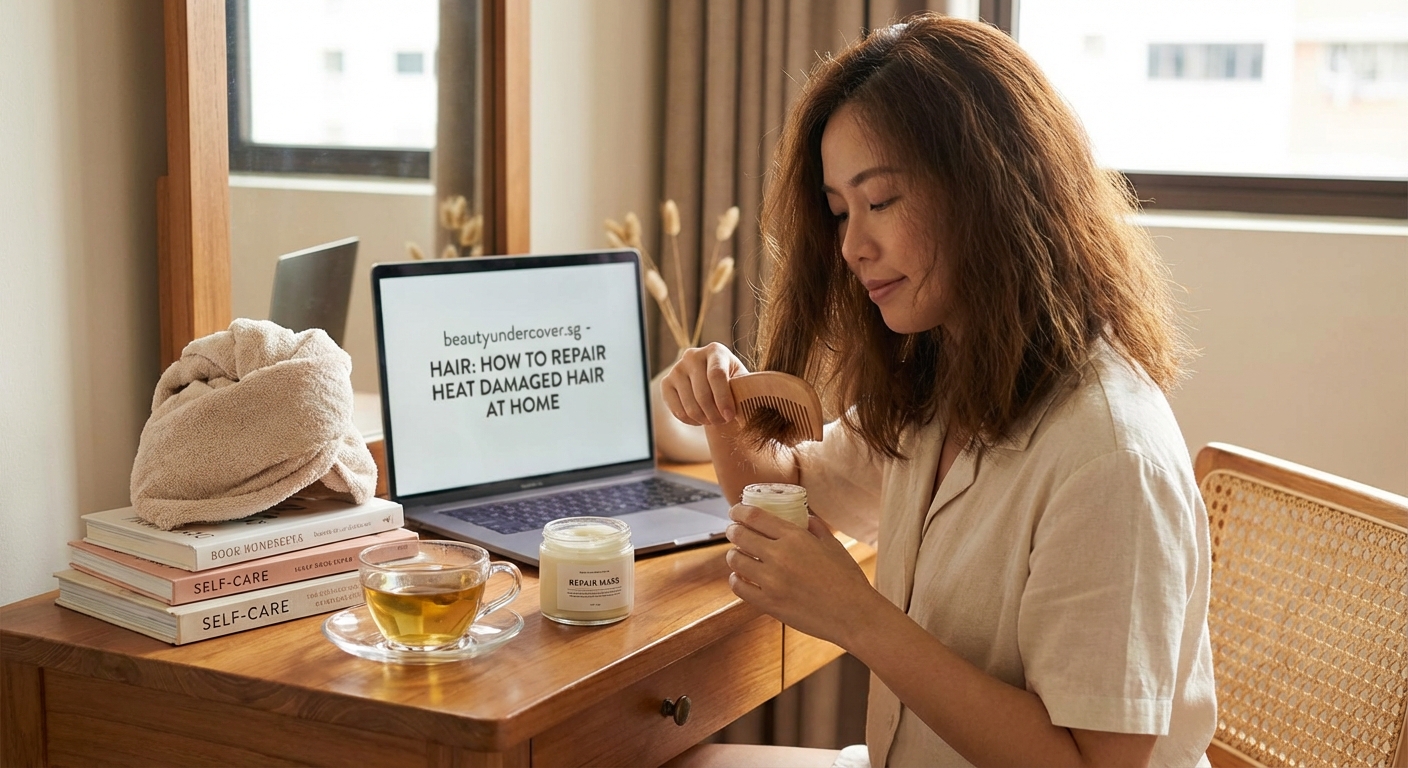
Before you can repair anything, you need to stop the cycle. This means a complete heat styling break for at least 30 days.
Put away the flat iron. Skip the curling wand. Let your hair air dry or use the cool setting only.
I know this feels impossible if you’ve been heat styling for years. Your natural texture might feel unfamiliar or unmanageable. But every additional heat session while you’re trying to repair is like trying to heal a cut while repeatedly reopening it.
During this break, learn to work with your natural texture instead of against it. Braids, buns, and headbands become your best friends. Embrace the texture you’ve been hiding.
The repair timeline you should expect
| Damage Level | Visible Improvement | Full Recovery |
|---|---|---|
| Light (occasional heat use, minimal breakage) | 2-3 weeks | 6-8 weeks |
| Moderate (regular styling, noticeable texture change) | 4-6 weeks | 10-12 weeks |
| Severe (daily heat, significant breakage and splits) | 6-8 weeks | 3-4 months |
Your hair grows about half an inch per month. Repair happens from the inside out as you strengthen existing strands and grow new, healthy hair. The damaged sections don’t magically transform overnight.
Protein treatments rebuild broken bonds

Heat damage destroys protein structures. You need to put protein back in.
Look for treatments containing:
- Hydrolyzed keratin (small enough to penetrate the hair shaft)
- Hydrolyzed wheat or silk protein
- Amino acids like cysteine and methionine
- Collagen peptides
Use a protein treatment once per week for the first month, then every two weeks for maintenance.
Here’s how to apply it properly:
- Wash your hair with a gentle, sulfate-free shampoo to open the cuticle slightly.
- Squeeze out excess water until hair is damp, not dripping.
- Apply the protein treatment from mid-shaft to ends, avoiding the scalp.
- Cover with a plastic cap and let it sit for 20-30 minutes (check product instructions).
- Rinse thoroughly with cool water to seal the cuticle.
- Follow immediately with a moisturizing conditioner or mask.
That last step matters. Protein without moisture makes hair brittle. You need both.
“Hair is like a sponge. When it’s damaged, it has holes. Protein fills those holes and gives hair structure again. But a dry sponge is brittle. You need moisture to keep it flexible and strong.” – Trichologist perspective on protein-moisture balance
Deep conditioning restores moisture balance
Heat damaged hair loses its ability to retain water. The lifted cuticle lets moisture escape as fast as you add it.
Deep conditioning treatments work differently than regular conditioner. They contain:
- Heavier oils (argan, coconut, olive) that coat and seal
- Humectants (glycerin, honey, aloe) that attract moisture
- Emollients (shea butter, ceramides) that smooth the cuticle
- Silicones (dimethicone, cyclomethicone) that provide temporary sealing
Apply a deep conditioning mask 2-3 times per week between protein treatments. Leave it on for at least 30 minutes. Heat helps it penetrate better, so sit in the sun or use a warm towel wrapped around your head.
The key is alternating protein and moisture. Too much protein makes hair stiff. Too much moisture makes it mushy. You’re looking for strength with flexibility.
Bond repair products target the deepest damage
This category changed home hair repair completely. Products containing bond-building technology work at the molecular level to reconnect broken disulfide bonds.
The most researched ingredient is bis-aminopropyl diglycol dimaleate, but newer formulations use different bond-building compounds.
These products work best when used as a system:
- Add a bond-building treatment to your hair while shampooing (if the product line offers one).
- Apply a bond repair mask or intensive treatment weekly.
- Use a bond-building leave-in or serum daily.
You’ll see results faster with bond repair products than with protein or moisture alone. Hair feels stronger after the first use. Real structural repair takes 6-8 weeks of consistent application.
They’re more expensive than regular treatments, but you need less product and see results that actually last.
The right way to wash damaged hair
How you wash matters as much as what you use.
Damaged hair is fragile. Rough handling during washing causes more breakage than you realize.
Follow this method:
- Brush hair gently before getting it wet to remove tangles.
- Wet hair thoroughly with lukewarm water, never hot.
- Apply shampoo only to your scalp, not the length of your hair.
- Massage your scalp with fingertips, not nails.
- Let the shampoo rinse through your ends naturally as you rinse.
- Apply conditioner from ears down, avoiding roots.
- Detangle gently with fingers or a wide-tooth comb while conditioner is in.
- Rinse with cool water to close the cuticle.
Wash only 2-3 times per week. Overwashing strips the natural oils your damaged hair desperately needs.
Between washes, use dry shampoo at roots only or rinse with water and apply conditioner to ends.
Protective styling gives hair a break
While your hair heals, it needs protection from friction, manipulation, and environmental stress.
Protective styles keep ends tucked away and minimize daily handling:
- Low buns secured with scrunchies (never tight elastics)
- Loose braids (French, Dutch, or simple three-strand)
- Twist-outs or braid-outs that don’t require heat
- Silk or satin head wraps
- Soft headbands that don’t pull
Avoid styles that create tension at the hairline or crown. No tight ponytails, slicked-back buns, or styles that pull.
Sleep on a silk or satin pillowcase. Cotton creates friction that roughens the cuticle and causes breakage while you sleep.
Refresh styles with water mixed with leave-in conditioner in a spray bottle. Never brush dry, damaged hair.
Ingredients that actually repair vs. ingredients that just coat
Not all hair products do what they claim. Some provide temporary cosmetic improvement without actual repair.
Ingredients that repair:
– Keratin and hydrolyzed proteins
– Ceramides and 18-MEA
– Panthenol (pro-vitamin B5)
– Bond-building compounds
– Amino acids
Ingredients that coat (helpful but temporary):
– Silicones (dimethicone, amodimethicone)
– Heavy oils (mineral oil, petrolatum)
– Film-forming polymers
Ingredients to avoid on damaged hair:
– Sulfates (SLS, SLES) that strip too harshly
– High alcohol content (SD alcohol, isopropyl) that dries
– Strong clarifying agents used too frequently
Read ingredient lists. The first five ingredients matter most since they make up the bulk of the formula.
Common mistakes that slow down recovery
You’re trying to help your hair, but these habits work against you:
Using too much protein. Hair feels stiff, breaks easily, and looks dull. This is protein overload. Switch to moisture-only treatments for 2-3 weeks.
Skipping trims entirely. Split ends travel up the hair shaft and cause more breakage. Trim 1/4 inch every 8-10 weeks to remove the most damaged ends without losing significant length.
Expecting overnight results. Hair repair takes time. Stick with your routine for at least 6 weeks before deciding if it’s working.
Trying too many products at once. You won’t know what’s helping. Pick a routine and stick with it for a month before adding or changing products.
Going back to heat too soon. One flat iron session can undo weeks of progress. Wait until hair shows consistent improvement before reintroducing any heat.
Building a realistic weekly routine
Here’s what a repair-focused week looks like:
Monday: Wash with protein treatment, follow with moisturizing conditioner. Air dry in protective style.
Tuesday-Wednesday: Refresh style with water and leave-in spray. Sleep on silk pillowcase.
Thursday: Deep conditioning mask (moisture-focused). Leave on 30-60 minutes. Air dry in protective style.
Friday-Saturday: Refresh style. Apply bond-building serum to ends.
Sunday: Wash with bond-building treatment if using a system, or regular gentle shampoo and conditioner. Air dry in protective style.
Adjust based on your hair’s response. If hair feels stiff, add more moisture. If it feels mushy or stretchy, add more protein.
When to consider a small trim
Sometimes the ends are too far gone. If you have:
- Splits that extend more than an inch up the hair shaft
- Ends that tangle into knots within hours of detangling
- Severe breakage that doesn’t improve after 8 weeks of treatment
- A clear line where healthy hair meets damaged hair
A small trim removes the worst damage and helps the rest of your hair recover faster. You don’t need to cut it all off. Even 1-2 inches can make a significant difference.
Ask for a “dusting” or “search and destroy” trim where the stylist only cuts individual split ends rather than blunt cutting across all your hair.
Your hair can recover from this
Heat damage feels permanent when you’re running your fingers through dry, broken strands. But hair is remarkably resilient when you give it what it needs.
Commit to 60 days of no heat, consistent treatments, and gentle handling. Take a photo today and another one in two months. You’ll see the difference in texture, shine, and strength. Your hair won’t feel like straw anymore. It’ll start acting like hair again.
The healthier your hair gets, the easier it becomes to maintain. You’ll spend less time fighting tangles and breakage. And when you do eventually reintroduce heat (sparingly, with protection), your hair will be strong enough to handle it without falling apart.
Start tonight with what you have. A deep conditioning treatment, a gentle detangle, and a silk pillowcase. Small, consistent actions rebuild what heat broke down.
Leave a Reply